OPTIC AND HOST QUESTIONS
sfp managed network switch
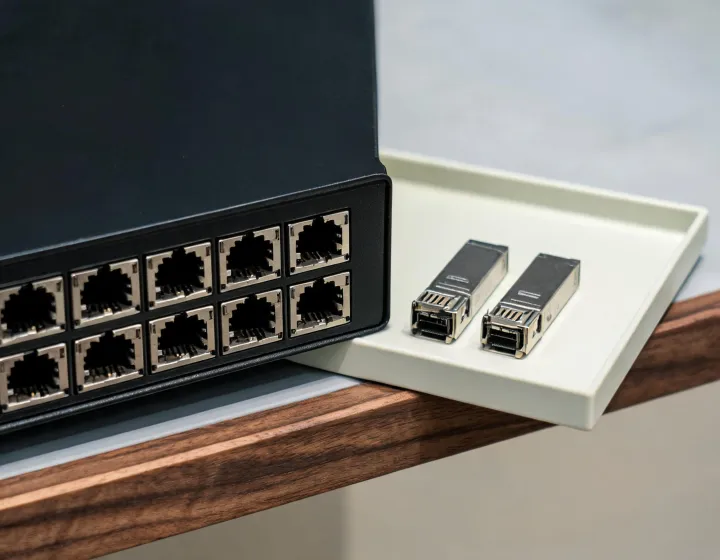
An sfp managed network switch quotation becomes comparable after the cage, the optic, and the host coding policy are written as separate lines. LinkScope Sourcing 14 sends that packet to factories. The desk does not code transceivers and does not decide which host will accept them.
Treat 1 Gbit/s SFP and 10 Gbit/s SFP+ as different cages unless the datasheet says the port trains down. A matching latch photo is not a speed test. Write the host platform name in the brief so each factory answers the same compatibility question.
Prepare a Telecom RFQFields each factory must price on the optic line
Keep the switch chassis and the optic on neighboring rows. A bundled price that hides the optic wavelength cannot be checked against the fiber plant.
- Cage type and port speed: SFP at 1 Gbit/s, SFP+ at 10 Gbit/s, or the combo behavior if copper and optic share a port.
- Wavelength and fiber mode: 850 nm multimode or 1310 nm single-mode are common question values. Reach in meters stays with the optic, not with the switch marketing line.
- Optical budget: transmit power, receiver sensitivity, and the connector loss you measured. Insertion loss on the patch and return loss on a bad end-face are plant facts the supplier cannot see.
- Coding and host policy: OEM-coded modules may align more directly with a vendor support policy. Compatible modules may widen the supplier list when the exact host is tested. Neither statement is a result from this desk.
- Commercial exclusions: optic, license, freight, duties, and whether the rate is per switch or the whole order.
Single-mode and multimode do different jobs
| Question | Single-mode optic | Multimode optic |
|---|---|---|
| Plant | Matches longer runs when the fiber and the wavelength agree, often discussed near 1310 nm. | Often discussed for shorter data-hall runs near 850 nm with compatible fiber. |
| What to demand | Reach, connector, and optical budget against the measured loss. | Core size, reach, and whether the switch port is SFP or SFP+. |
| What not to assume | A single-mode label does not certify the proposed model. | A multimode jumper photo does not set the switch forwarding rate. |
The ITU fiber recommendation and the IEEE 802 overview, both used here as question sources checked on 2026-10-27, do not replace the optic datasheet tied to a manufacturer and model.
Evidence to request before an alternative optic is accepted
Which document names the exact item?
Ask for a current datasheet that shows manufacturer, model, wavelength, reach, connector, and temperature. A family photo of several latches is not that document. If the optic is refurbished, ask for condition, DOM support, and remaining warranty months as separate sentences.
What does the host policy say?
Some platforms log a third-party EEPROM and some block the port. The supplier should state whether the reply assumes an OEM-coded part or a compatible part, and which software release was used in any compatibility note. This site does not repeat another seller's support promise.
How is loss checked?
Request the test method for transmit power and receiver sensitivity, including the temperature. Calibration traceability of the optical meter belongs to the lab that measured it. A connector mating cycle count matters when the same port is reseated during staging.
Which costs stay outside the optic?
Fiber jumpers, attenuators, cleaning tools, license keys for the switch, and commissioning labor. List them so a lower optic rate is not compared with a turnkey uplink. Quantity and destination still set freight.
See inquiry cards and the buyer checklist before you send the packet.
Review the spec, then request the quotes
- Freeze cage, wavelength, fiber mode, and host name.
- Mark mandatory, preferred, and unknown cells.
- Ask each factory to flag deviations instead of silent substitutions.
- Compare currency on a per-switch or whole-order basis after exclusions are listed.
No upload field is attached to this form. Paste the optic row into the requirement box.